


If you’re an army looking to get through Central Asia, and don’t feel like crossing a mountain range or two, where do you go? Through Uzbekistan. It falls at the end of the Tien Shan and Pamir Mountain ranges, made up of an open, and expansive desert broken up by the few rivers that twist through the region. It’s full of trade, oasis cities, and the empires that always seem to follow tax revenue. The Mongols, the Scythians, and even the Umayyad Caliphate all controlled this region for part of the last few thousand years. Now, all that’s left of those empires are stories and the ruins of thousands of years of history dotting the arid countryside.
We took a bus from the western side of the country all the way back to the capital of Tashkent in the east. This trip started when we flew out to Nukus, a small city in the sparsely populated western end of the country known as Karakalpakstan. As our trip progressed, we stopped at a number of old sites that stood in the desert, slowly being eroded by the blowing sand. Immediately, once we got into the countryside, it felt entirely unfamiliar. Unlike in Kazakhstan, where we had seen either steppe or mountains, this was clearly desert. Sand, small shrubs, and the blazing sun dominated the landscape.
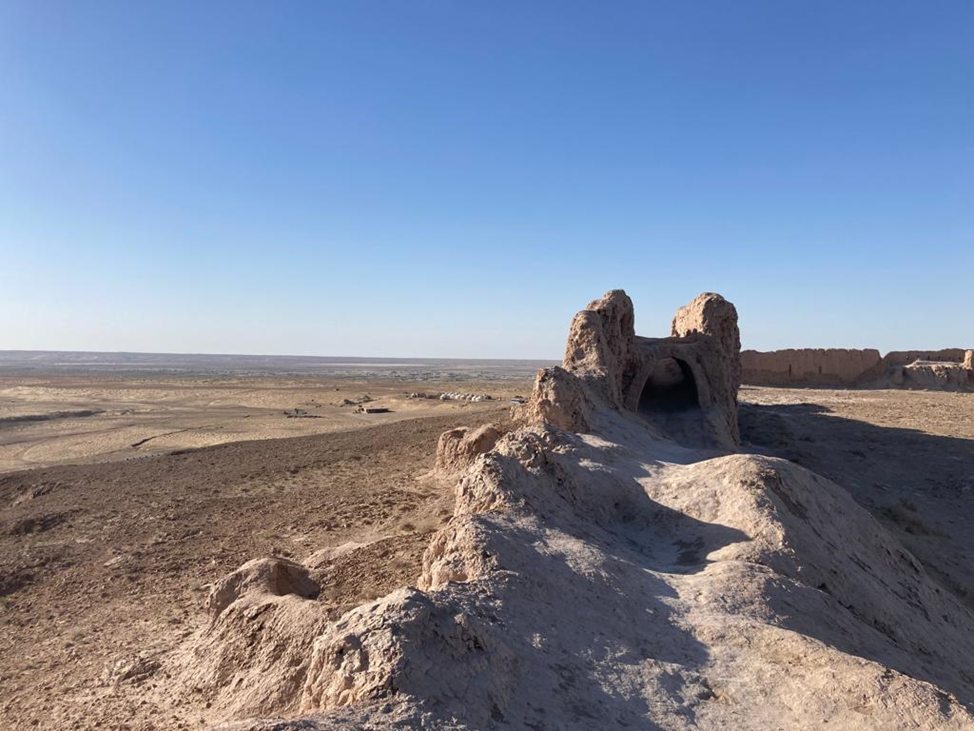
An ancient wall of a fort out in the desert
In this sandy expanse, one of the first places we were brought to, was an old city, which our guide called Antioch. Not the famous one of the Roman era, but it shared the same name. At first glace, it just looked like nothing more than a large pile of dirt, before I realized the city is likely the dirt itself or underneath it. It was large, but no more than a square kilometer. And being young adults who are at a cool ancient site, we decided to climb on top of this massive dirt pile.
As we climbed the dirt pile, we found a lot of random sharps of ceramic pottery laying around. At one point, I looked down to see three shards of pottery at my feet that looked entirely unrelated. Once, we were atop the dirt pile, we saw some degrading towers off in the distance and went to go investigate. We found ourselves off on the other side of the dirt pile. Here we found walls, hallways, and rooms built up, but only partially intact. It too had fallen victim to time and erosion, but that did not stop us from running around on the walls. While they were slowly turning to dust, they still functioned as a good way to cross the tiny city built on an even more ancient city.
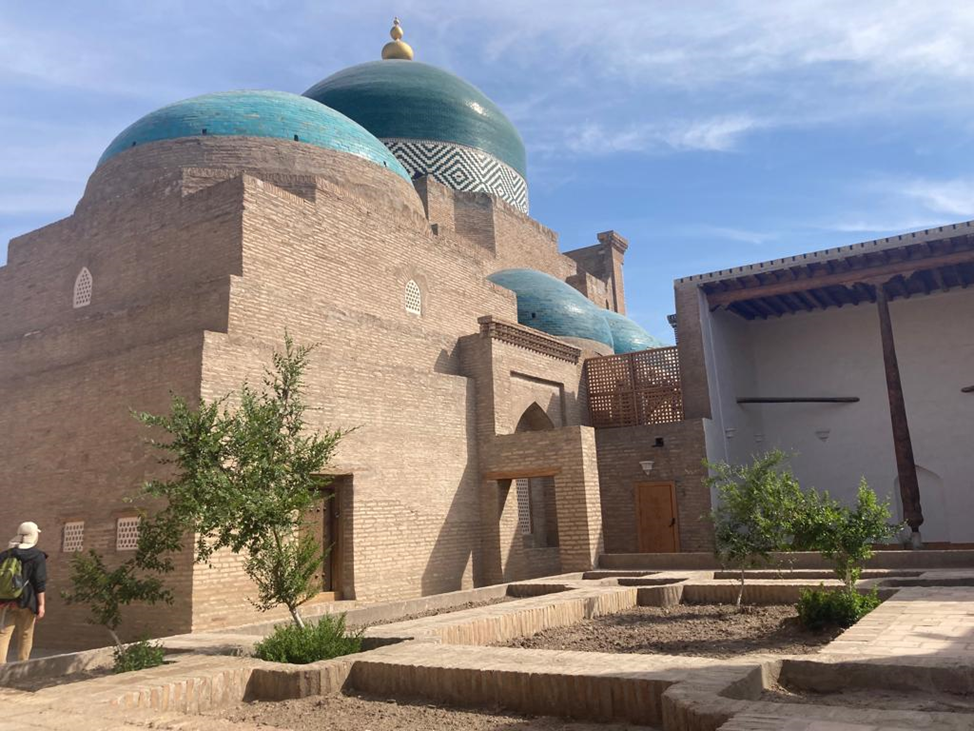
A Mosque
Later in our trip, between Khiva and Bukhara, we were taken to a different ancient ruin atop one of the highest points for dozens of miles. At first glance it looks like some old fortress that didn’t pass the tests of time, but our guide revealed that it was in fact an ancient Zoroastrian site called a Tower of Silence. In Zoroastrian burial practices, the body is not buried as that would contaminate the earth, but in fact given over to the elements. This is done using a Tower of Silence, which is essentially a large walled-off area on a naturally high area that allows for wild animals, particularly vultures, to consume and strip the flesh from the body, cleansing it. However, this Tower of Silence had not been in use for over a thousand years due to the introduction and prompt dominance of Islam in the region.
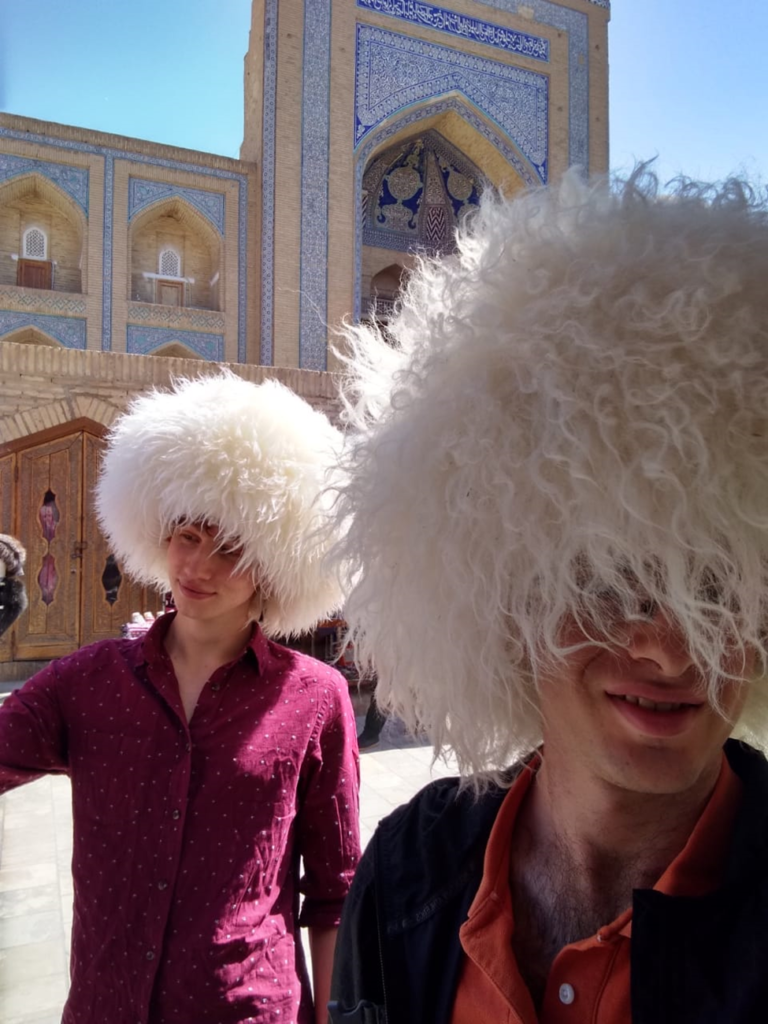
Ezra and I trying on traditional headwear in Khiva
We saw plenty of ancient sites, but what was almost more interesting than what we saw was what we were not shown or told. Not once on this trip did anyone mention something the USSR did, other than damaging a few ancient sites due to their use of bombs during the revolution and the following war. We talked about many different time periods pre-1900s, including a few dates as far back as before the common era (BCE). In fact, at one point we talked about the late 1800s through the beginning of the 1900s, without a single mention of what came immediately after. If you were a tourist who knew nothing about the recent history of Uzbekistan, you would have barely known the USSR ever existed, controlled this region.
It made it very clear that tourism in the country is trying to project an image connected to its more ancient past. We were shown tons of mosques and madrassas, but not one building built between 1917 and 1991. This tells us something interesting about how the country sees itself, or at least how it wants the rest of the world to see it. It’s not just another post-soviet state. It’s a country with a storied history that goes back millennia, unique in dozens of ways, shaped by many empires, and especially shaped by the silk road. This is the history the country wants to remember, not the USSR.
