


A young child is standing in a dim and cramped train car. His grandfather is reciting a prayer in Hebrew, while the young boy, Sashka, is trying to hand him water. As soon as the grandfather finishes praying for the boy’s safety, he dies, leaving Sashka trapped on a train car with no family, and nobody to take care of him.
This is the opening to The Gift to Stalin, released in 2008. This film is set in 1949, after World War II, but still in the midst of Stalin’s reign. It focuses on the tale of Sashka, a nine year old Russian-Jewish boy who was being deported across Kazakhstan. That is, until he’s snuck off the train by the rest of the deportees on the train car. He’s hidden with the dead bodies which get intermittently unloaded and sent to be buried wherever. As the train departs, he finds himself in the presence of two railway men in a tiny Aul, village, where nobody is quite sure what to do with him.
Throughout the film, we spend most of our time in the Aul itself. Characters like Ezhik, a deportee, Vera, a former inmate in the Alzhir gulag, and Kasym, a railway man. They all try to make sure that Sashka is in good hands once he arrives in the Aul, but they have to hide who he is from the authorities. This leads to Sashka receiving the new name of Sabyr, a Kazakh name.
But keeping an escaped deportee child beneath the radar is not so easy. They must lie, and mislead the authorities, even as they are clearly suspicious of this newcomer. Through this process of keeping him safe, Kasym grows close to Sashka.
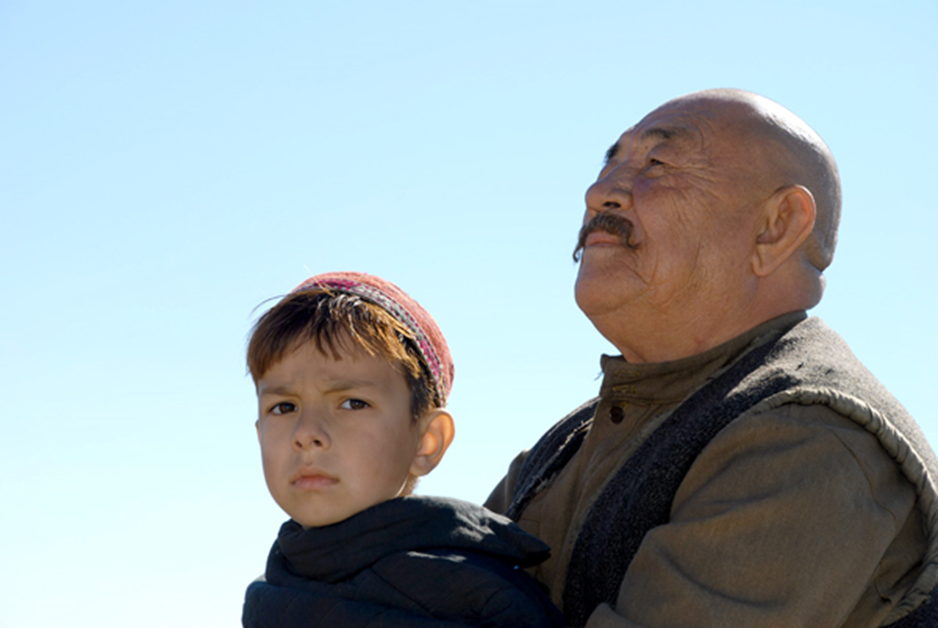
Sashka (wearing a Kalpak) and Kasym
Their relationship blooms throughout the film, a bright spot amongst the horror of the Stalinist times, with Kasym beginning to call Sashka son, and Sashka calling him grandpa. The two could not be more different at first glance, a older Muslim Kazakh and a young Jewish boy. But in hiding Sashka as Sabyr, he gives some bits of Kazakh culture over to the young boy, with Sashka wearing a Kalpak (a traditional hat), and even begining to speak some Kazakh.
Through this, they bond. Kasym is trying to keep the boy alive, to get him back to whatever family he has left. He takes him to the grave he dug for his grandfather, where Kasym prays. He plays the Dombra (a traditional Kazakh instrument) for him when he arrives in the village to calm him down. He is the one who takes on the takes on responsibility for making sure this nine year old boy stays safe, and does his absolute best to raise him in the absence of anyone else to do so.
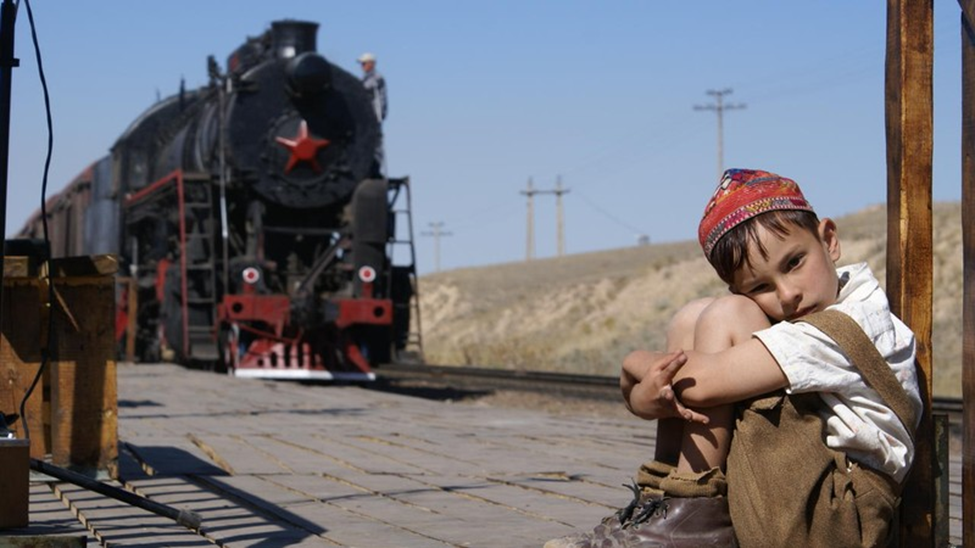
Sashka sitting against a pole as a train pulls into the small station
The trains, and the train tracks they travel down, are a central presence throughout the film. Sashka’s story opens and closes on the train, bracketing his time spent in this temporary home, with the unusual family that he finds. The tracks are also a stark contrast to the steppe, where there is little more than endless grasslands. They’re the sign of civilization, and the way that USSR can assert itself in the area. In this tiny town of exiles, former Gulag inmates, and locals, the trains keep coming through, carrying food, soldiers, and deportees.
The USSR needs more than just trains to assert itself, and the local military officers are more than happy to provide a ruthless and often violent Soviet presence in the town. The first of them is Balgabai. A heavyset Kazakh man, who seems to exist primarily to make sure that others are scared of him, and only secondarily to execute the will of USSR. Our second character is Balgabai’s boss, a Major in the army who appears infrequently, but always brings fear along with him. They’re the instruments of soviet terror in this town, as far as their concerned, Stalin is simply the figurehead of the violence.
This film shows first-hand that even the most horrific of regimes can’t do it by themselves. These dispassionate institutions require dispassionate men who instill fear for its own sake. Men willing to implement any and every policy handed down to them.
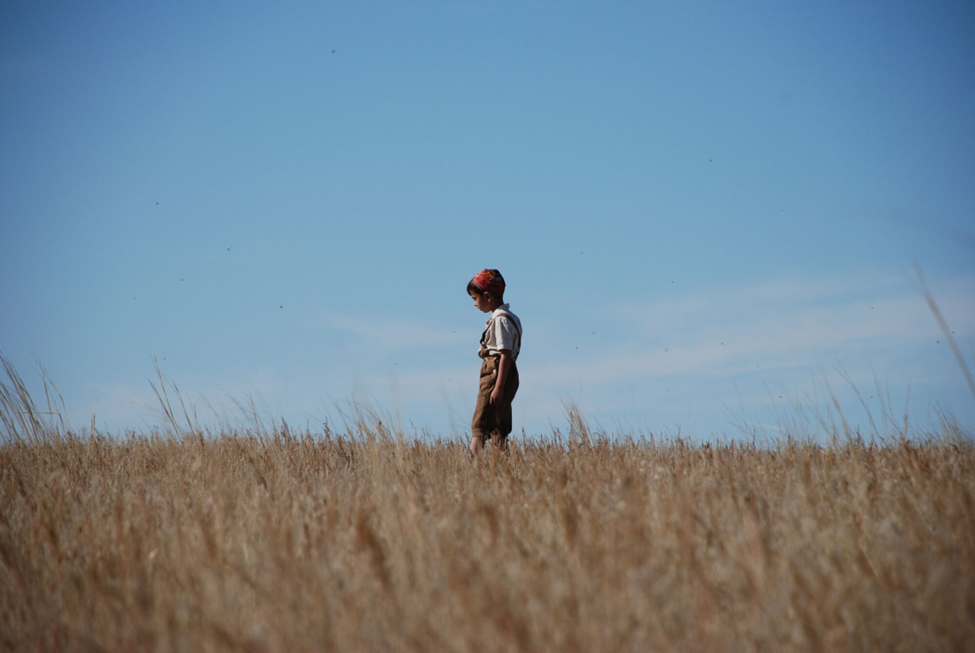
Sashka alone on the steppe
Nowadays, very few people are left alive who lived through this period of time. Nobody who suffered in the gulag, Alzhir, is left alive. Nobody who was deported in the 1940s either. However, in this film, we’re taken back through a story based on the memoirs of David Markish. Turning the emotionless statistics that define Stalin’s violence into people. Showing us how the USSR turned lives upside down seemingly for no reason at all.
The title of the film, The Gift to Stalin, references Stalin’s upcoming 70th birthday. At various points in the film, people are aggressively reminded of this upcoming birthday, and are encouraged to provide gifts to Stalin. The first time this happens is when the Red Army Major comes into town. He pointedly asks whether Sashka would gift the goat he’s holding to Stalin. Kasym standing to the side, chooses not to engage as the Major turns his attention to him and tries to provoke him. However, as the Major gets back in his car and starts to leave, Sashka runs up to the car and offers the goat as a gift to Stalin. He asks that the Major tell Stalin he sent the gift, hoping that Stalin will let him be reunited with his parents as a result.
The second gift comes at the end of the film after Sashka has left. The gift is the first nuclear weapons test performed in the USSR, on Stalin’s purported 70th birthday. This test destroys the Aul which kept Sashka safe, but leaves the residents alive. Just the final twist of the knife against a town and people who have done nothing wrong but must suffer anyway.
