


Just as labyrinthine and seemingly convoluted as the old cities themselves scattered throughout the desert of Uzbekistan, are the priorities of the Uzbek government when it comes to cultural preservation and the image of itself it presents to tourists (also called the destination image). In my mind, the old cities have an excuse — they are piecemeal cities/fortresses/rest stops on the Silk Road that were built hundreds of years ago by dozens of different political leaders and imams (Muslim religious figures who held a heavy hand in education in the Islamic world). But when it comes to projecting an image of modern Uzbekistan, the current department of tourism seems not to have an identity or a vision of its own nation. In our travels throughout the country, this stood out to me most in the лавки — tiny market stands and storefronts that hawk souvenirs to tourists — that overwhelmed each cultural heritage site that we visited.
My impression of Uzbekistan as a station on the ancient Silk Road, a bastion of cultural heritage, and a window into the history of Central Asia, stood in conflict with how it presented itself as one large tourist trap and interconnected scam market with just one bulk supplier. As soon as you walk into the old cities, it’s impossible to avoid the cacophony of voices in Russian, English, Uzbek, and occasionally French (if they think we look Parisian enough) from both sides of the dusty brick road calling at you to look at their assortment of mass-produced souvenirs. Whether it be jewelry, or colored silk scarves, or wood dolls they paint to look “Uzbek,” they are all reportedly handmade by the individual shop vendors. This was obviously false, as each and every shop had the same assortment of memorabilia, but I always asked as it was fun to listen to them each explain how they learned to sew, paint, knit, wood and metal craft, and harvest silk just outside of the old city.
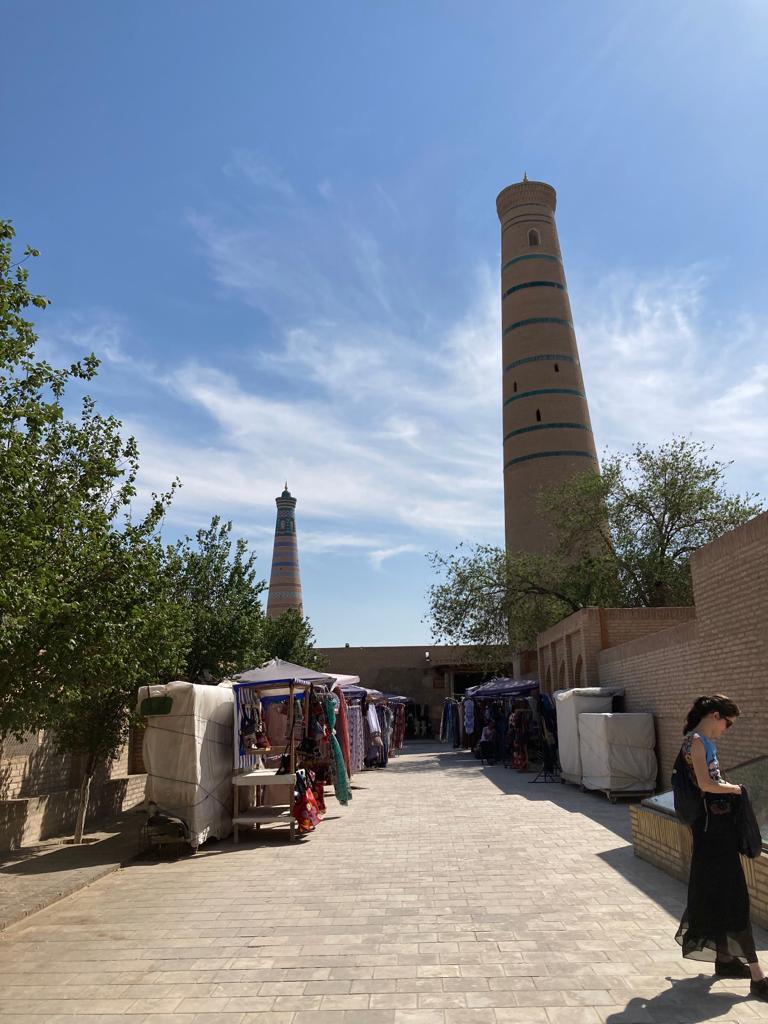
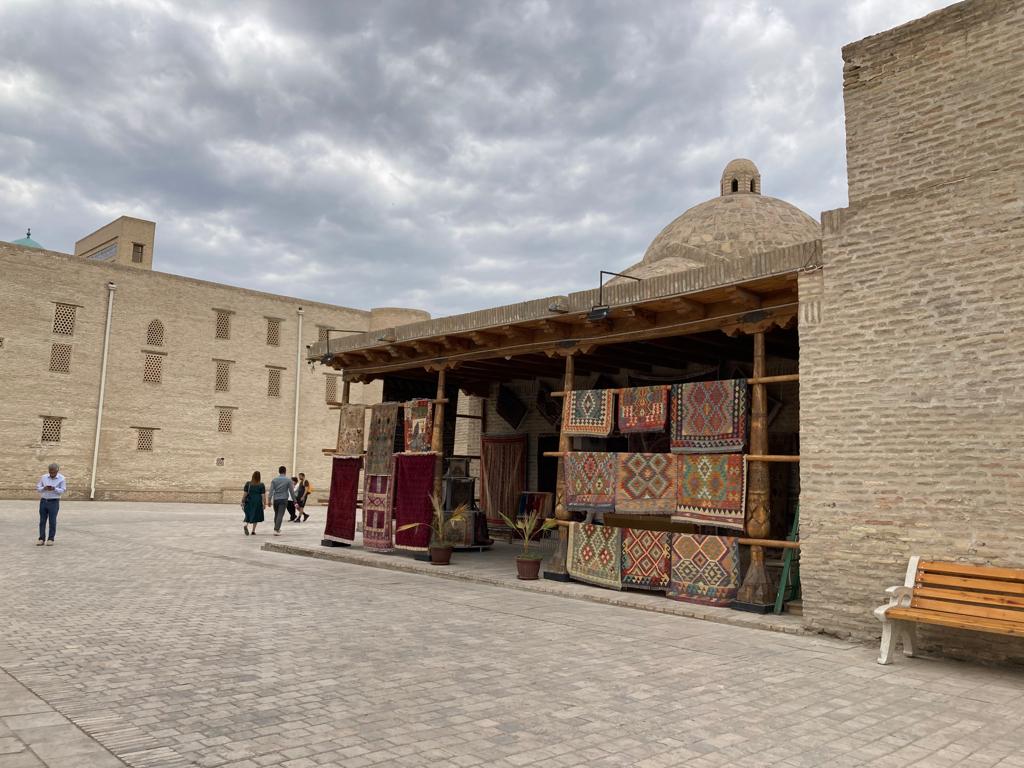
All across the old cities were madrassas and minarets, to lookout towers and old clay walls. The Uzbek government, in collaboration with UNESCO, has done a great job preserving architecture from all the way back to the 10th century and beyond. However, it was hard to appreciate it, while being yelled at to buy a book-holder and magnets I’ve seen two dozen times earlier that day. I think I spent more time thinking about where in Bangladesh they were being manufactured than I did about the minarets themselves. The profit margins must be insane.
Most interesting to me were the shops selling Soviet memorabilia. Pins featuring Lenin were proudly on display at some storefronts, old Soviet-era Uzbek money and coins were showcased, and one even hung a portrait of Stalin and flags of the various SSRs. This particularly stood out, as the rest of Uzbekistan that we had seen had ridden itself of much of the Soviet influence. Compared to Kazakhstan, Uzbekistan has distanced itself from its near past, instead focusing on its far past. These specific shops that seemed to worship the Soviet era were the outliers. The destination image put on display by the government and the shops here differed most.
My favorite shops were the ones that sold clothes, as they demonstrated at least the image of what Uzbek dress may have once looked like (and we could try them on!). Dresses and robes featuring Uzbek national patterns such as the khan-atlas and others influenced by Zoroastrianism (the religion of ancient Central Asia), were topped with traditional Uzbek hats made of sheep wool. Some stores even sold paranji, a long robe like a burqa that covers the face and has “false sleeves” in the back that can be tied together or hang loose to signify the marital status of a woman in traditional society, and whether or not she has children. Seeing European and American tourists walking around wearing paranji made the trip almost into a comedy, knowing the traditional meaning of the dress.


After our week and a half long trip across the country, I’m still not sure what my takeaway is. I can’t define Uzbekistan with a single idea; I’m left with an unsatisfactory concoction of modern and historical Uzbekistan. When I picture the madrassas, the sanctuary of education and truth in the Turkic world, I only imagine the vendors who were trying to make a quick buck by lying to tourists. The minarets now attract more Americans to spend money than they do Muslims to pray.
It’s also hard to differentiate the cities in my head, as what stood out most was the uniformity of the stores across the nation. Even the art stores, which were more authentic than most, as the artists actually sat outside and we could watch them paint Uzbek landscapes and animals constructed from Arabic calligraphy, featured very similar paintings.

A little advice for people thinking about traveling through the old cities in Uzbekistan: Don’t tell the vendors where you are from before they tell you the price — they will charge you American prices. Bargain, bargain, bargain — vendors are often willing to cut the price in half if you push enough; if not, then find another store. Talk to the vendors about their lives. They often want to go to America or have a family member in New Jersey or Texas (the only two states they know in the US). But get something — even if you can find it everywhere, it will be a good memory. My purchase was a pink camel wool scarf.
All of this is not to say this is objectively bad, as Uzbekistan rakes in profits from tourism that they are investing in themselves, generally a positive in national development. It suits a certain lifestyle, and that is not mine. However, my trip to Uzbekistan will always be stained with a hollow, and lackluster image of the nation and the Silk Road. I’m now happily back in Almaty.
