


What do you know about Qazaqstan? Where I’m from, most people know very little. There’s a sense it’s a big, Muslim, post-USSR country in Central Asia, but that’s about it. If you picked up a guidebook, you might hear about the steppe, the mountains, the lakes, and the жайлау (zhailau, mountain meadows), or maybe about the nomads who have been here since the Paleolithic age, or perhaps about the Han, Mongol, Russian and Soviet empires who variously controlled the area. Here, the first horses were domesticated and the first apples plucked, the book exclaims triumphantly.
But writing from Almaty, the old capital, it’s hard to feel like I’m in the same country. Almaty is an inverted city compared to the rest of Qazaqstan–a thousand times more densely populated, exhaust-filled air, no horses or apple trees to be seen. Even the maps are inverted, showing south as up, because the ground slopes upwards to the southerly mountains and people use this to navigate. I’m not the only one who feels this way: a poem about Almaty by Pavel Bannikov is titled “Beloved Mordor.” The name is apt, in some ways: vast peaks, smog, and the Ritz-Carlton skyscraper standing tall above my university campus like the Eye of Sauron.

The sunset from Kok-Tobe, a hill on the outskirts of the city
So yes, when I arrived here, I thought living here would be an exercise in loving an ugly face. But I’ve quickly come to see it differently. Behind each window of the gray concrete хрущёвки (khrushchyovki, apartment buildings constructed under direction of Nikita Khrushchyov) is a bright, warm, quiet apartment just like my own. The offensive graffiti covering the fence belies the care taken by my host family inside to preserve a clean, welcoming space. They make me put on my slippers (tapochki) and wash my hands every time I return, and some families even change into indoor clothes. On my daily walks now, I see the plants waking up from winter, reaching for the наурыз (nauryz, holiday for the start of spring) decorations which hang across the avenues and twirl in the wind. People go out of their way to get up for an older person on the bus, people wait for the crosswalk signs to change, a church worker lets our student group up into the bell tower, a woman holds a friend’s backpack in her lap for the whole bus ride, someone offered me free food at a pigeon market (yes, they buy and sell pigeons) when I couldn’t pay, and everyone wants to start up a conversation, asking “откуда вы?” (atkuda viy, where are you from). I am pleasantly surprised to report that if this is Mordor, the orcs are quite nice, actually.

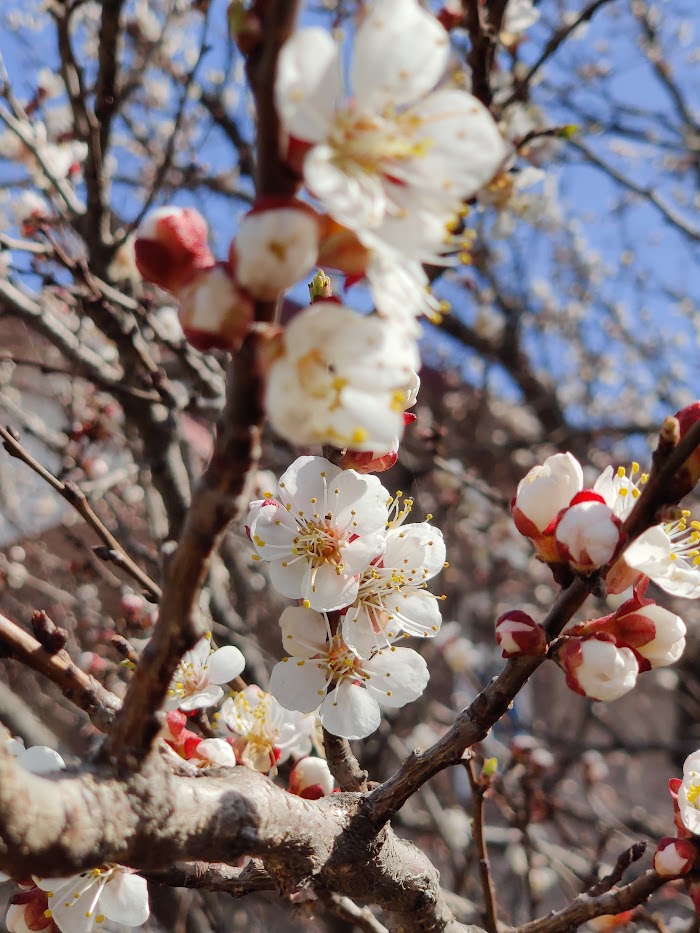
The first flowers I saw blooming in Almaty
And even more than nice things, there are all these odd little things: we find an intricate, golden piece of the roof of a Soviet palace of whatever several miles from where it was removed for renovations, looking totally out of place, covering a hole in a shack in the oldest part of town. Walking to a grocery store with friends, a babushka shouts out her first floor kitchen window at us: “сколько сейчас время?” (skolko seychas vryemya, what time is it). I tell her it is 4:15. A Russian software engineer I met on a ski lift, here fleeing the war, tells me he has no friends or relationships with him or back in Russia. He says he’s antisocial but I don’t believe him because he spoke to me first in the quiet gondola. All the street signs on one avenue near my house have been smashed, showing the zigzag pattern of their LED light backings. It feels like something we’re not supposed to see. Don’t you want to know more? There is a story behind each of these, and I swear I’ll try to tell it.

The ever-present mountains from the campus of Al-Farabi Qazaq National University
But I’m just a bumbling American, two weeks off the plane. The world here is just beginning to come to life in my head, so I can’t make grand statements about what it means to be Qazaqstani, I can just repeat what I’ve experienced, read or been told. This is something new for me, writing about the reality around me and not about some book or movie. Never before have I tried to engage this deeply with a place or its people. But I think I’m ready: my mind has been pried open by the liberal arts, and it’s just been dunked into the river of culture. I am filling up, and perhaps I will catch some interesting flotsam that you can read about.
This flotsam will primarily consist of thoughts on Qazaqstani identity and how it is being developed. I will also do an interview (with whom is unknown as of now), and write reviews of books/media we read, which will be submitted for publishing in The Alma Review, an English-language site which hosts reviews of Qazaqstani literature. I also plan to make at least one video while I’m here, which will be posted on my YouTube channel. I would recommend reading my friends’ blog posts while you’re on the site, they are covering topics like the alphabet (why am I writing ‘Qazaqstan’ and not ‘Kazakhstan’?) and environmental activism (why is the air so smoggy?).
I hope I’ve sparked your curiosity about Qazaqstan. Every day here, the idea of this city grows in my head. I’ve tried to cut a little bit off and I hope it grows in your head too. It’s spring, when I write next, I expect the idea will be blooming!
– Zimri, from my book-filled room on Panfilova street, in the “Golden Square”, Almaty, Qazaqstan.


1 thought on “Coming to Life”