


Though they are neighboring post-Soviet countries in Central Asia, Kazakhstan and Uzbekistan are very different. The former’s wide steppes, mostly inhabited by nomads until the 20th century, stretch out in every direction, while the ancient walled cities of the latter form a line across the desert, following the Silk Road and the Amu Darya river. These cities are the centerpieces of the Uzbek government’s attempts to entice international tourists to visit the country, a strategy which seems to have worked, as Samarkand, Bukhara, and Khiva were all filled with tourists. Under the tiled minarets of their leaning mosques and madrassas, the streets and squares of each city’s historic district are lined with booths selling everything from identical, mass produced refrigerator magnets, to leftover Soviet medals and coins, to painstakingly handcrafted silk carpets.
The art of silk making started out as a closely guarded Chinese secret, but spread west through a combination of industrial espionage and trade. In this century, Uzbekistan has occupies third place in the ranking of leading silk producing countries. The process of making silk fabric begins with the mulberry tree, ubiquitous in Uzbekistan, whose leaves are fed to specific types of moth larvae (silkworms). The larvae then spin cocoons, but never emerge as moths because the cocoons are boiled, which dissolves the sericin gum which the worms use to cement the valuable fibers of which the cocoons are made. The silk filaments, only about a quarter of which are long enough to use, are spun into thread on a wheel. Silk is extremely strong, as one rug maker we met demonstrated by grabbing one of his rugs and twisting part of it as hard as possible, which he claimed would have caused cotton threads to break.
We visited three rug making workshops, the most sophisticated of which was the Samarkand Bukhara factory. Located in a spacious, modern, freestanding building rather than a small, brick room behind a market stall, the factory was founded in 1992, shortly after Uzbekistan’s independence, by immigrants from Afghanistan. As shown in photographs on the wall, It has been visited by such notable figures as Hillary Clinton, John Kerry, Vladimir Putin, and Dmitry Medvedev.
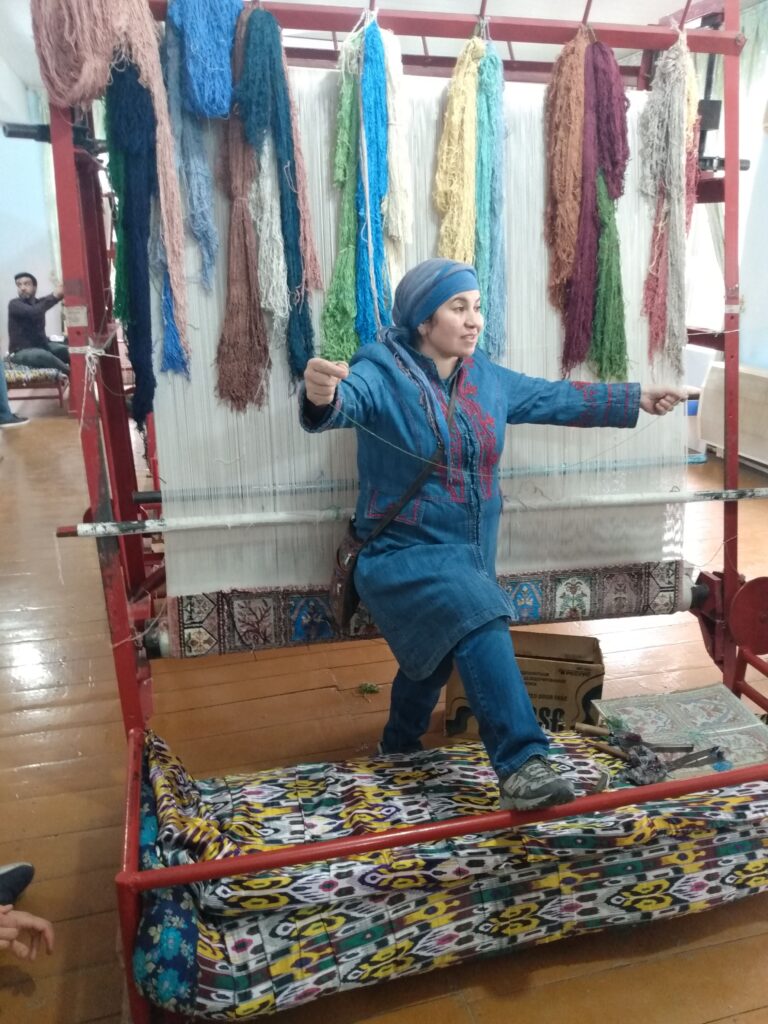
Turning silk into rugs is a painstaking process. According to the tour guide at the Samarkand Bukhara silk rug factory, completing a full size rug can take one worker working 8 hours a day a year and a half. The backbone of each rug is composed of a series of parallel strings which are stretched vertically on a special frame. To create each pixel of the pattern on the rug, the rugmaker ties a short piece of silk thread around one of the parallel strings and ties it into a knot, cutting it so that the knot’s loose ends are facing in the direction that will be up when the rug is placed on a floor. Supposedly machine made rugs can be told apart from handmade ones by the lack of visible knots. Left to right, bottom to top, the rug slowly comes together as each pixel is checked off on the piece of paper showing the rug’s planned pattern. If a mistake is made, our rugmaker said the solution is usually to and keep going and hope nobody notices.
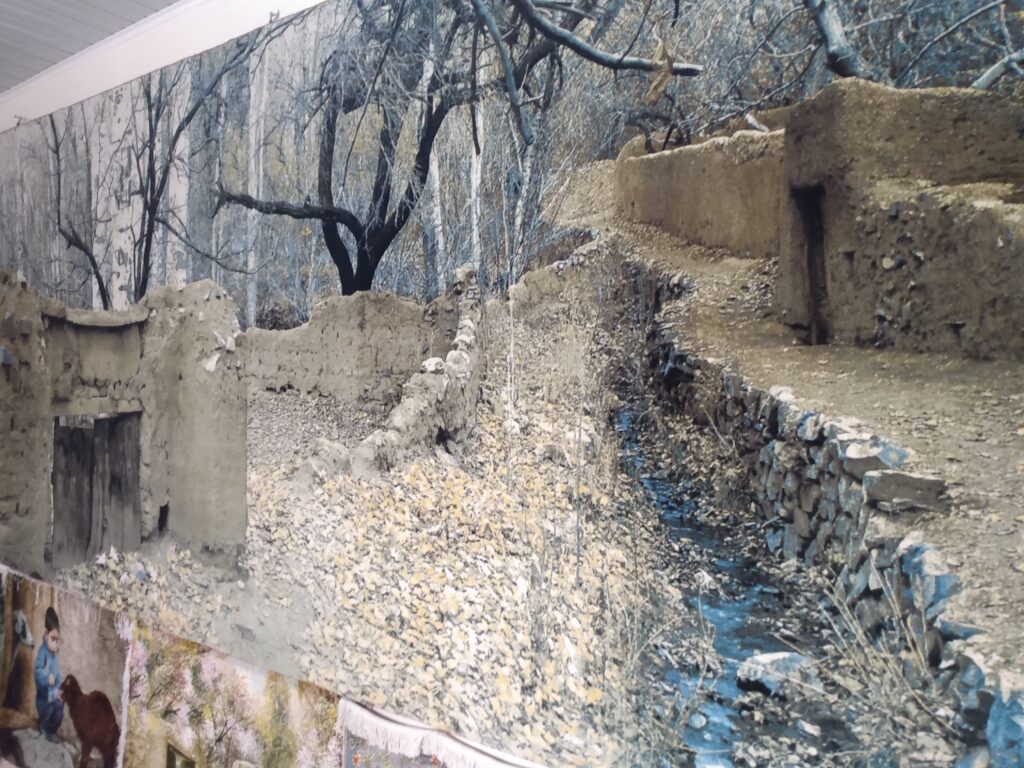
In addition to traditional patterns, the Samarkand Bukhara factory (located in Samarkand) produces stunning representational rugs, which are indistinguishable from photographs at a distance. They don’t just stamp a photograph onto a blank rug, rather each pixel of the picture is literally a separate piece of thread of the appropriate color.
Uzbekistan’s markets contain other products than silk rugs and scarves however. One of the most impressive to me was the foldable wooden book holders. They come in a number of forms from large, mass produced ones composed of two pieces of wood with the eight pointed star and crescent moon laser cut into them, to smaller, handmade examples made of four pieces of wood, connected by interlocking wooden fingers. Most interestingly, they can assume several different positions suited to differently sized books and even cell phones. They seem like they would most be useful to people who often read sitting on the ground, or have one big book they want to display in an open position.
Knives were another good of which I saw a lot. Most of them had some sort of writing (in Arabic, Cyrillic, or Latin script) or image (usually the skyline of one of the cities) engraved into the blade. Some had handles shaped like animal heads or even made of apparently real horns or hooves. Apparently a lot of them were made in the city of Chust, which we didn’t visit, but is famous for making knives with an upward curving tip. There were also a few (dull) swords for sale.
One markets we visited mostly contained stands selling food, from raw cuts of meat to dried fruit to halva, an originally Iranian desert every batch of which tastes different in my experience. Merchants aggressively offer customers free samples in hopes of persuading them to buy.
All in all, the biggest difference I perceived between Uzbekistan and Kazakhstan was that the shadow of Russia and the Soviet Union which still hangs heavily over the latter has receded more in the former. Russian is less widely spoken and not a state language. I met several people who simply didn’t speak it, conversing in English and Uzbek instead. The Uzbek language’s transition from the Cyrillic to the Latin alphabet is much closer to completion. Perhaps most importantly, Soviet-era architecture fades into the background, making up a much smaller portion of the total number of buildings in Uzbek cities. The “Khruschevka” apartment buildings of Tashkent coexist with a quarter of the city which dates back to when the only buildings in Astana were yurts. Today, Uzbekistan’s ancient structures are experiencing a new chapter in their history, as tourism destinations which connect visitors from around the world to the country’s traditional crafts.
