


I have never been shot at. Our tour guide has, though. She’s a little older than I am, a former student of my professor, with beautifully dyed hair, wearing an intricately patterned, comfortable skirt, and a shirt with a picture of a sheep underneath her vest. With tentative English she told us stories about Soviet murals and dam-building megaprojects, about the Palace of the Republic and the distinctively dumpling-shaped Qazaq State Circus building. In particular, I remember sitting on a bench with her and laughing, because she had just pointed out yet another bland-looking building, telling us it used to be so beautiful, before the “renovations”. The Palace of the Republic lost its intricate, golden roof tiles, a beautiful, huge mural of a snow leopard was painted over with a Coca-Cola ad, and an old tile mosaic on the Palace of Weddings was half cut off to make room for a door. It seemed like everything had been ‘modernized’. But in the back of my head, I wondered something. How did the renovators not notice that on the street next to my house, all the street signs have been smashed?

Do you remember reading a headline about Russian paratroopers in Qazaqstan? The signs were broken then, as the Russians landed, a year and a half ago, during the January Events. They were a series of митинги (meetingy, “protests”, a euphemism from English, now part of Russian) that took place all over the country. When I arrived here, everything I knew about them was from a paragraph in the New York Times, and so when my professor said that our tour guide had participated in them, I had to know more. We were sitting around a big table in the Green Bazaar eating блины (bliny, Russian pancakes) when I broached the subject.

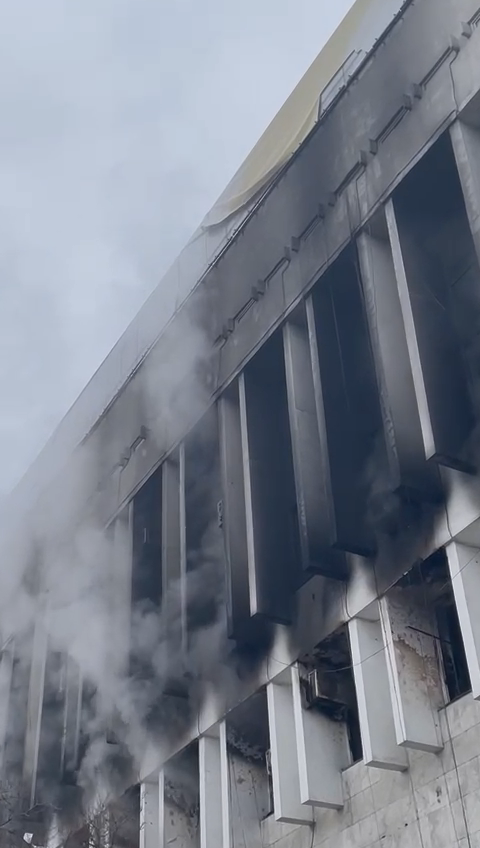
The Akimat burning. Credit to my guide
It was a foggy day, but that might have been the tear gas. She was there, standing in the middle of an empty Al-Farabi Prospect on January 6th, in front of the burned out Akimat (city hall) building. President Tokayev had just, for the first time ever, called in the Collective Security Treaty Organization’s forces (think Russian NATO), the Russian paratroopers had landed, and she had received an official text message saying there was a terrorist danger, that “идёт зачистка” (idyot zachistka, “a clearing is under way”). She went out anyway. When I asked her if she was afraid, she said, “yes, I was worried for safety, but not thinking I will die today, I was maybe thinking there will be a stun grenade near me”. She had no way of knowing that President Tokayev had ordered the national security forces to “shoot to kill without warning,” because the order was announced on television, which she doesn’t watch, and social media, which was blocked due to the protests. Her mother was calling her, afraid for her life, when the gunshots started. She ran, saw someone lying on the ground, face up, with a bullet wound. It felt like she was in a movie. She said you can still see the impact holes on some walls on Al-Farabi Prospect.
She told the story with a calm voice, continuing to eat her блины. The delivery felt wrong, like she was just reciting the plot of the movie she saw. How could she speak about death, maybe even her death, with a steady gaze, pausing to answer questions? But it’s all real. Everywhere around the city I see signs of it, not just broken signs, but art:

Art in the waiting room of a contemporary theater. I wonder who those parachutists are…
Two hundred and twenty-seven people died that day, by the official count. Who were they? What were they fighting for? There were no websites with lists of demands and signatures. Everything I heard felt like a rumor: were there criminals released in the crowd, to make it more violent? Was Putin orchestrating the whole thing? Or was it an internal power struggle? One thing was clear though. Again and again, I heard a name, the same name as the street with the broken signs: Nazarbayev.
Now, I understood why they were broken. Nursultan Nazarbayev is the first president of the country, the former Leader of the Nation (this is an official title given only to him), and the former Chairman of the Security Council, whose picture hangs in museums, schools, and my volleyball gym. He was prime minister of the republic from 1984 to 2019, surviving the breakup of the Soviet Union. He resigned and peacefully transferred power to Kassym-Jomart Tokayev. His parting speech simply cites a desire to help the “rise of a new generation of leaders”. It does not cite that he would remain the Chairman of the Security Council and the leader of the Amanat political party, the most powerful in Qazaqstan.
This was one (of many) things people were fighting against. The people I spoke to wanted every trace of his influence gone. After the protests, he lost his Security Council position and fancy title, and the capital was renamed back to Astana (meaning “capital”). But nothing else changed. The protest slogan is still shel ket (“leave, geezer” in Qazaq), just aimed at Tokayev instead of Nazarbayev, and many of the problems Qazaqs face are the same: cronyism, nepotism, corruption and a devalued currency. The dead got a memorial which my guide called a “slap in the face”. No names of victims, no families invited, just some low-quality concrete blocks with vague quotes from poems. So, I actually appreciate the glowing LED strings from the signs hanging off buildings that I see every night, because they remind me that this pleasant, busy street was once filled with tear gas and broken glass. But every time I walk by, I’m afraid they will have been repaired. What then will have come of these people’s lives? It will be just another thing my guide will point to, and say, “renovations”.

One of the first protest actions, by Asiya Tulesova, who was arrested for it
FROM THE TRUTH DO NOT RUN
#IHAVEACHOICE
