


Before visiting Uzbekistan, I had no idea what to expect. I knew roughly where it was and its Soviet past, but that was about it. This trend is the same among my friends and family: minimal location and history knowledge. Now that I’ve visited, I feel as though I have a responsibility to reveal the secrets of Uzbekistan, demystifying it for those who remain unaware. The easiest way to do this is through my catalog of photos, the best of which I have sorted into a folder named “Uzbekistan Favorites.” This folder contains 30 photos. The criteria for the photos in this album are as follows: No repeats (different angles of the same thing count as repeats) and they have to be photos that I would post on Instagram (I want other people to see these photos). It’s unreasonable to expect that this album will encapsulate all that Uzbekistan has to offer (it’s only 30 photos!). However, I’m interested in knowing how the photos I’ve taken reflect and affect the world image of Uzbekistan.
To answer this question, I will compare the photos in “Uzbekistan Favorites” with the results of a study conducted by Fayzullaev, Cassel, and Brandt which analyzes the image of Uzbekistan created by its official website and the image of Uzbekistan created by online users. Fayzullaev et al. use a few terms which will now be defined. The term ‘destination image’ is defined in its most concise form as a “subjective perception of an objective reality, which every individual creates in [their] consciousness” (Fayzullaev et al., 2021). For example, my parents’ concept (destination image) of Uzbekistan (objective reality) is created through their interpretations of the photos (subjective perception) that I have shown them.
The main goal of the study is to compare the destination image created by Uzbekistan’s
official website to the destination image created by Instagram users. To identify these two groups, Fayzullaev et al. use the terms DMO and UGC. DMO is an acronym for ‘destination marketing organization’ and refers to the institution behind the creation of the official website. UGC is an acronym for ‘user generated content’ and refers to any content posted online (for the purposes of this study ‘online’ refers to Instagram)(Fayzullaev et al., 2021).
To compare these photo sets, the authors created three general categories into which each photo was sorted: Heritage/Sightseeing, Nature/People, and Entertainment/Recreational (Fayzullaev et al., 2021). Fayzullaev et al. discuss the differences between percentages of photos that fall into each category between DMO published content and UGC. By sorting the photos in “Uzbekistan Favorites” into each category and comparing the results to that of Fayzullaev et al., I believe I can begin to understand how the photos I’ve taken influence the destination image of Uzbekistan.
Here is a categorical breakdown of the folder “Uzbekistan Favorites”:
Heritage/Sightseeing: 25/30 (83%)
Nature/People: 5/30 (17%)
Entertainment/Recreational: 0/30 (0%)
A few photos were chosen to highlight the content in each category (for those categories that have photos):


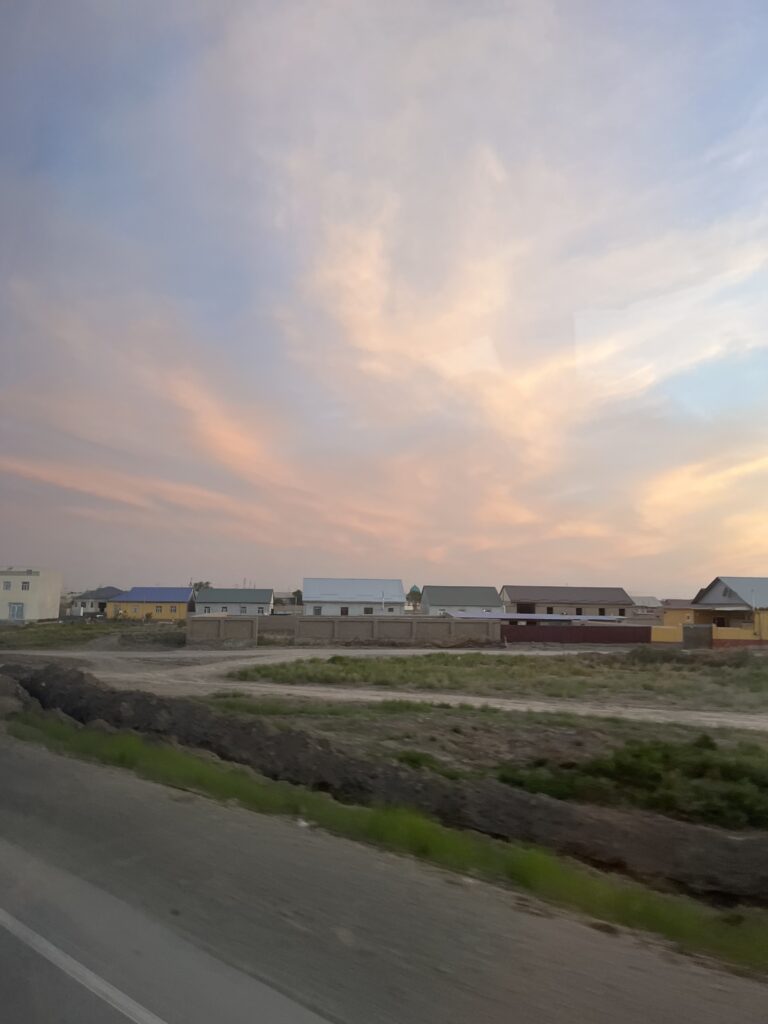
Given that I am a tourist of the country and am not associated in any way politically with Uzbekistan, the photo set “Uzbekistan Favorites” should be considered an extension of the UGC destination image. Let’s see how these photos compare with Fayzullaev et al.’s results.
Heritage/Sightseeing photos were posted on the official website at a rate of 87% and on Instagram at a rate of 65% (Fayzullaev et al., 2021). Photos in “Uzbekistan Favorites” are found in this same category at a rate of 83%. In this category, my photos more closely support the destination image created by the government of Uzbekistan.
Nature/People photos were posted on the official website at a rate of 4% and on Instagram at a rate of 26% (Fayzullaev et al., 2021). The photos in my album are found in this same category at a rate of 17% which more closely supports the destination image created on Instagram.
Finally, Entertainment/Recreation photos were posted on the official website at a rate of 10% and on Instagram at a rate of 9% (Fayzullaev et al., 2021). The photos in “Uzbekistan Favorites” are found in this same category at a rate of 0%. All of these values are low, so this result generally supports both destination images. However, this result, as well as all other results should be taken with a grain of salt given the low sample size of the photo album.
In conclusion, the photos I have taken of Uzbekistan generally support the destination images created both by the government and by users on Instagram. The results of this analysis were achieved by observation of the statistics which is to say that the analysis is fairly informal and should be taken lightly.
Works Cited:
Fayzullaev, Kamoliddin, Susanna Heldt Cassel, and Daniel Brandt. “Destination Image in Uzbekistan – Heritage of the Silk Road and Nature Experience as the Core of an Evolving Post Soviet Identity.” The Service Industries Journal 41, no. 7–8 (June 11, 2021): 446–61. https://doi.org/10.1080/02642069.2018.1519551.
